Designed by function, lived by journey
47%of customers leave after two or three poor interactionsGENESYS ’26

Practices
CX Strategy Design Studio Innovation Lab All 22 Solutions Add-ons Configure your engagementBy role
CMO CINO CTO / CIO CPO CEO & C-SuiteLearn
Whitepapers Knowledge Base Delivery Methodology FAQsTools
ToolKit f/cx.ai Online Tools Template Library Readiness Assessment AmorphiaUI AIDownload
Brochures & Solution Catalog All ResourcesWritten for the CTO and the CIO
Every AI commitment made in front of a customer lands on your side of the house as an integration, a retrieval accuracy number, a run cost, and an audit trail. This is what changed, what you are measured on, and where f/cx.ai plugs in.
face budget cuts or freezes if AI targets are missed
CIO SURVEY ’26say explainability gaps delay or stop production
CIO SURVEY ’26of AI initiatives are meeting or beating their goals
STATE OF CIO ’26say staff build AI faster than IT can govern it
CIO SURVEY ’26regret a major AI vendor or platform choice
CIO SURVEY ’26of CX infrastructure is fully cloud-based today
GENESYS ’26Bought by function · lived as one journey
Every function is putting AI into the customer path on its own plan, budget and scorecard. The customer meets all of it as one experience. The seams between functions are where value leaks, trust breaks and AI spend loses its return — and no single function owns them.
From the CTO / CIO seatPlatforms get bought before the journeys they serve are designed, so data and integration debt surface after signature.
Six plans, six AIs, six numbers. One customer falls through the seams. One experience graph under every function. The seams become designed handoffs.
Three failures underneath it
What f/cx.ai does instead
f/cx.ai is a customer experience design and innovation agency built to own the seams — one direction, one model, one measure.
Across every function that touches the customer — strategy, research, design and AI in the path, from one agency.
The ToolKit puts the same evidence and visible weights in front of every seat.
Gates and a measurement frame agreed up front, so year two survives.
AI adoption × customer experience
Pick a pressure on the map — each gauge is the figure behind it
71% of CIOs face cuts or freezes if AI targets are missed, and 85% now have compensation tied to measurable AI outcomes — while only 19% of AI initiatives are meeting their goals.
A platform investment argued on faith in its second budget cycle.
Fewer than half report adequate data quality and access for AI. IDC expects CIOs who defer data debt remediation to see 50% higher AI failure rates by 2027.
Model underperformance that is really a knowledge and pipeline problem.
85% say traceability and explainability gaps delay or stop projects from reaching production, and 70% expect new AI audit or explainability requirements within the year.
A build that passes QA and still cannot be launched.
82% report employees standing up AI faster than IT can govern it, and 54% have already found unsanctioned tools in use inside the business.
Customer data in systems nobody scored, owned, or logged.
74% regret at least one major AI vendor or platform decision from the past eighteen months, and 62% have had a CEO question one of them.
Integration debt discovered after signature instead of before it.
82% of CX leaders expect autonomous agents to orchestrate the experience within three years, while only 31% of CX infrastructure is fully cloud-based today.
Orchestration promised on a stack that cannot decide in the moment.
Read it as one sentence. The expectation is now contractual and the substrate is not ready, so the constraint on the 2027 experience is knowledge quality, orchestration capability, and evidence a regulator would accept — decided journey by journey, before the platform is chosen rather than after. That is a design and decision problem, which is the work f/cx.ai does.
Five books, one composite
Uptime and delivery stayed. Data readiness, AI in production, and audit-grade traceability were added, and the technology seat is now measured on business outcomes it does not fully control. These are the measures the board reads together, and the constraint that breaks each one.
Pick a book on the ring for its measures and the constraint that breaks it
Throughput is high and none of it reaches the customer path.
Knowledge is treated as content rather than as a system requirement.
Deflection is counted as success and the customer calls back.
Evidence is assembled for the audit instead of captured during the build.
The value case was written by someone who will not own the run cost.
Challenge → engagement → artifact you keep
Pick a challenge to trace its wire to the engagement that answers it
CX AI Readiness & Opportunity Assessment — A ranked backlog with a modeled return per line, and an investment narrative finance can defend.
Contact Center Modernization & Agent Assist — Knowledge rebuilt to the standard retrieval actually needs, with cited, confidence-gated assist in the flow.
CX Governance, Trust & Enablement — Guardrails with enforcement and named owners, evaluation sets, and red-team evidence before build.
CX Strategy & Operating Model Design — Decision rights, funding routes, and the forums that turn scattered activity into scheduled work.
Fractional CX Leadership — A vendor evaluation scorecard weighted against your journeys, and commitments pressure-tested before signature.
Agentic Service Design & Deployment Plan — What AI resolves, what it must never touch, and escalation that carries full context to a person.
Start where the decision is
Pick a line to ride it into the gates
Not a presentation. One honest baseline for what AI can and cannot do across your experience, and a ranked shortlist the room built itself.
A data, knowledge, and platform audit across CCaaS, CRM, and the content retrieval would have to rely on, ending in a ranked backlog with a modeled return.
Guardrails with enforcement and named owners, evaluation sets, and red-team evidence — priced inside whatever it governs, never bought on its own.
Senior CX and AI direction in the room at the moment decisions are made, without a full-time hire or an agency bench underneath it.
Proprietary f/cx.ai IP
Twenty-two working decision-intelligence modules that move an engagement from nobody agrees what is true to a gated roadmap a board can fund. Not a deck — live models your team operates in the room, that change answers when an input changes, and that stay with your people when we release.
Hover a node, change the phase, or open the whole graph
What is actually true. The baseline nobody argues with.
A ranked value-leak list, each item traced to its evidence.
What we intend instead. Options tested before the expensive commitment.
A designed AI handoff, including the failure path — and the concepts that did not survive.
What we will and will not do. The phase clients skip.
A weighted ranking you set the weights for, and a not-this list with an owner.
What the board can fund. Sequence, gate, measure, hand over.
A gated roadmap, a measurement frame agreed before anything is built, and the model itself.
Inside the ToolKit
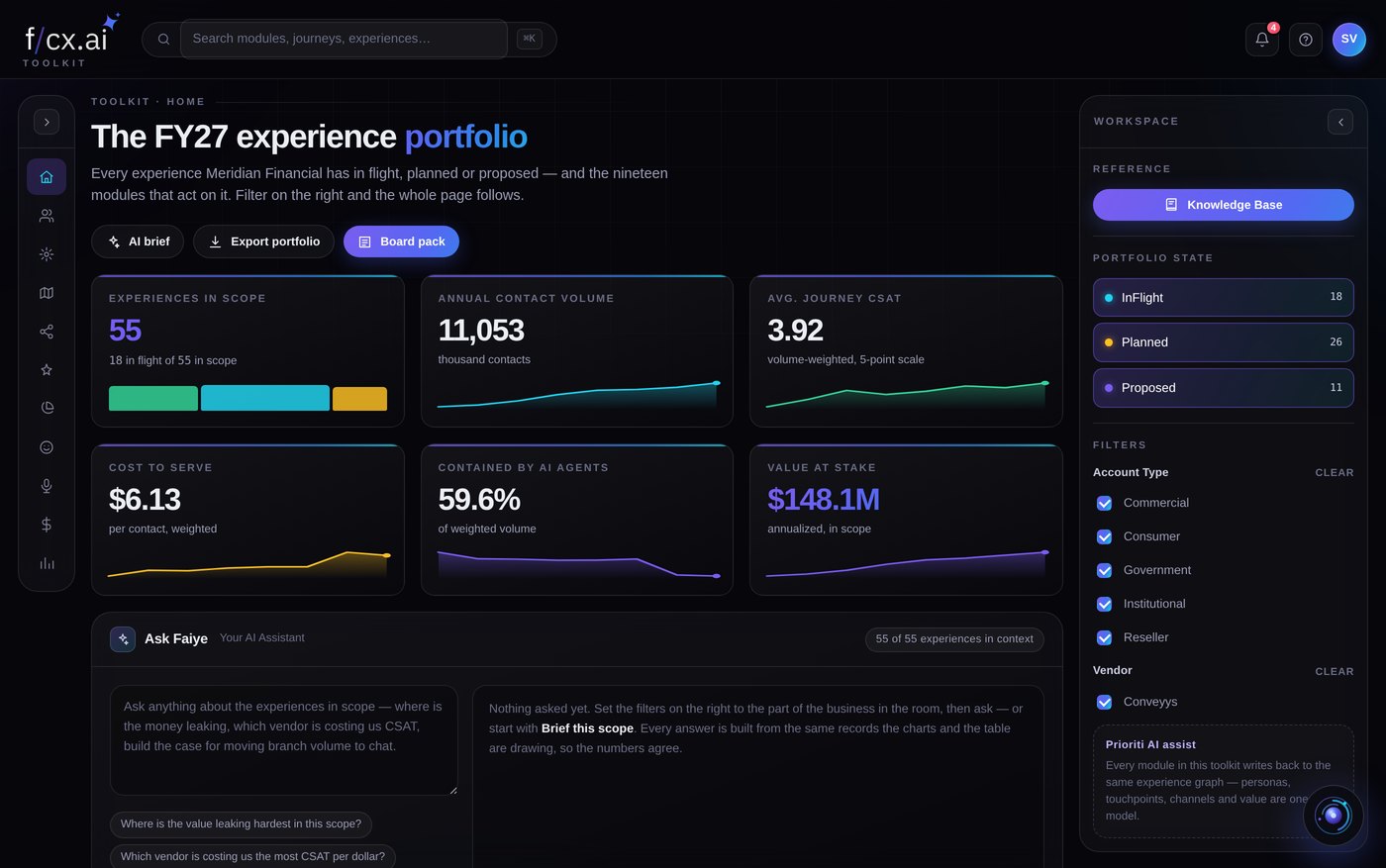

One view of every experience in flight, planned and proposed — volume, cost to serve, satisfaction, and the signals that should change what gets funded next quarter.
A ranked list of the decisions worth making this quarter, each with value at risk and model confidence attached.
Session one, every engagement. The fastest way to find out whether the client’s numbers agree with each other.
Every live experience by channel and persona, with the touchpoint events moving the numbers and the four measures the executive team actually asks about.
A defensible read on which programs are progressing and which are quietly degrading.
Steering committees and monthly reviews — it turns “how is it going” into a specific conversation.
The people the experience is actually for — each persona traceable to research, with needs, tasks and channel preference, scoping every other module.
A validated persona set the whole organization can name, with the research base behind each one.
Before any journey work. If the client cannot agree who the journey is for, nothing downstream survives review.
The journey as the customer experiences it — every touchpoint, what they are thinking, and where sentiment, effort and cost diverge from what the organization believes.
A journey map with evidence attached to every stage and the leak points quantified.
Discovery workshops. The sentiment-versus-belief gap is usually the moment the room changes its mind.
Who the base actually consists of, what each segment is worth, and which submarkets have no owner — click a segment and the whole page scopes to it.
A segment model with value index, coverage gaps and behavioral indices per segment.
Whenever growth targets and service design are being argued in different rooms.
Market and product sentiment across tracked dimensions, six months of movement, and the strategic landscape behind the scores.
A banded sentiment map showing where a category is still open, with evidence per dimension.
Competitive and category work — the weakest scores are usually where the opening is.
What customers are telling you, clustered and weighted, and where in the journey the telling turns into leaving.
Verbatim clusters ranked by volume and sentiment, tied to the journey stage they belong to.
When the client has plenty of listening and no synthesis — which is most of the time.
Point it at any experience asset — an interface, a website, a product, a portal, a digital journey or a service touchpoint — and it runs a structured AI audit end to end, scoring against the framework’s criteria and attaching a validated reference to every recommendation.
A decision package rather than a findings report: what is wrong, what to do, what it is worth, what inaction costs, and in what order — packaged for a formal accept-or-decline.
First contact with an existing experience, and the module most leadership teams reach for first. The fastest route from “this needs work” to a sequenced plan an executive can approve.
The journey as a policy rather than a map. The engine scores every candidate action across marketing, sales, commerce and service and selects the next best one in real time, for each customer, on every event.
An orchestration policy — the weights, the guardrails and the action mix they are willing to run — plus the value gap against their current fixed journeys.
When the client wants AI to run the journey rather than decorate it. The live race against their fixed journeys is usually what settles the argument about whether adaptive is worth it.
The orchestration behind the journey — every automated step, every handoff to a person, every exit. Drag to rearrange; connections and throughput follow.
A working orchestration model with throughput and loss at every step.
Designing agentic service. It makes the handoff design visible before anyone builds it.
How the same customer moves between channels — the handoffs that carry context, the ones that do not, and what each switch costs to serve.
A current-state and designed-state channel model with the cost of unnecessary switching quantified.
Cost-to-serve conversations. The switching matrix usually pays for the engagement on its own.
One idea, every credible way to build it, and the evidence for each — select the variants worth a two-week prototype sprint.
A sprint plan with criteria agreed before the build, and the economics of the answer.
Innovation cadence work. It is how a good idea stops being one person’s conviction.
Every finding, what it would take to fix, and what fixing it is worth — select recommendations and watch the composite move.
A scored recommendation set with gain per engineering week, ready to defend.
Building the funding case. The argument gets made here rather than in the meeting.
Where each capability operates today, where next year needs it to be, and the honest distance between the two across six maturity levels.
A capability-by-capability maturity read with the gap named and sequenced.
Executive briefings. Most organizations stall at Align — this is where they find out if they have.
Ten CX success drivers scored against a peer benchmark, weighted so the drivers that decide outcomes move the composite most.
A weighted composite against peer median, with strengths to hold and the constraints that decide next year.
Assessment delivery. Drag a score in the room and the radar answers immediately.
The same portfolio scored twice — once by the function that owns the customer, once by the function that owns the systems. The gaps are the agenda.
A value-versus-risk portfolio map plus a ranked list of where the two functions genuinely disagree.
When a program is stuck and nobody will say why. A two-point gap is a different-outcomes problem.
Where the experience opportunity is hottest set against whether the organization is ready to act on it — the gap between the two is the planning input.
An opportunity-versus-readiness map that separates capability investment from experience investment.
Portfolio planning across business units or sectors.
Every candidate feature scored on the same five criteria with the weights visible — move a weight and the ranking re-sorts live.
A ranked, weighted portfolio and a visible funding line.
The prioritization session. Agree the weights first; the list is then arithmetic, not politics.
Every initiative scored against the same alignment criteria — customer, business and technology — so the portfolio is argued on evidence rather than enthusiasm.
An alignment matrix with a defensible score per initiative and a not-this list that holds.
Whenever a client is running experience programs in isolation from the strategy.
The sequence, the decision gates and the dependencies — a roadmap the board can fund and the organization can execute in order.
A gated roadmap with investment by workstream and the dependencies that actually threaten it.
The last third of every engagement, and the artifact clients circulate most.
The measure a CFO will accept — value per customer moved by things the organization controls, with the employee data that predicts it sitting alongside.
A defensible RoX index and the leading indicators behind it.
Value realization and renewal conversations.
The practice network — what other people working the same problems are publishing, and the threads worth following.
A live channel between the client’s team and the f/cx.ai practice after the engagement ends.
Handover. Capability that lives with their people needs somewhere to keep growing.
One experience graph
Every module reads and writes the same model, so nobody re-keys a number or argues from a different spreadsheet. That is what “one experience graph” means in the room.
Built for the technology seat
Every panel is live — pick two seats, move a weight, drag a driver
One portfolio, scored by two seats at the table. Choose which two, and the distance between their scores is what the next meeting is actually about.
The gaps are the agenda.
Value × risk, scored by two seats
How the same customer moves between channels — the handoffs that carry context, the ones that do not, and what each switch costs to serve.
The switching matrix often pays for the engagement.
Red = context lost on switch
The orchestration behind the journey — every automated step, every handoff to a person, every exit. Rearrange it and connections and throughput follow.
Throughput and loss at every step.
Throughput and loss at every step
Value per customer moved by things the organization actually controls, with the leading indicators that predict it sitting alongside.
The measure a CFO will accept.
Index + leading indicators
Eight outcomes, not eight deliverables
A vendor scorecard weighted on your real journeys, not on the demo.
Surfaced in the audit, before the contract instead of after it.
Rebuilt to the standard retrieval needs, so the accuracy gate is passable.
Accuracy, safety, and escalation thresholds set while they are still cheap.
Every score and recommendation carries its evidence, six months later.
Decision rights, funding routes, and named owners instead of a ban.
Containment scored with resolution, escalation carrying full context.
The experience graph and scoring model stay with your people when we release.
Another seat at the table
Sources. 2026 CIO AI accountability survey; Foundry State of the CIO 2026; IDC 2026 CIO Agenda Predictions; Adobe 2026 AI and Digital Trends; Genesys 2026 State of Customer Experience.
f/cx.ai is a customer experience design and innovation agency for the AI era, working with enterprise organizations to design, prototype, and prove the journeys, service models, and AI agents their customers actually move through. Market figures cited are drawn from published industry research and are shown for context, not as a projection for any one organization. Engagement timing is set by scope and complexity and confirmed at scoping. ToolKit module outputs shown in any f/cx.ai material are illustrative and are not any named client’s results.